Cortisol has become a wellness villain, which is unhelpful, because you need it. It's what gets you out of bed, mobilises energy, and gets you through something hard.
The problem is never that you have cortisol. It's that it never comes down.
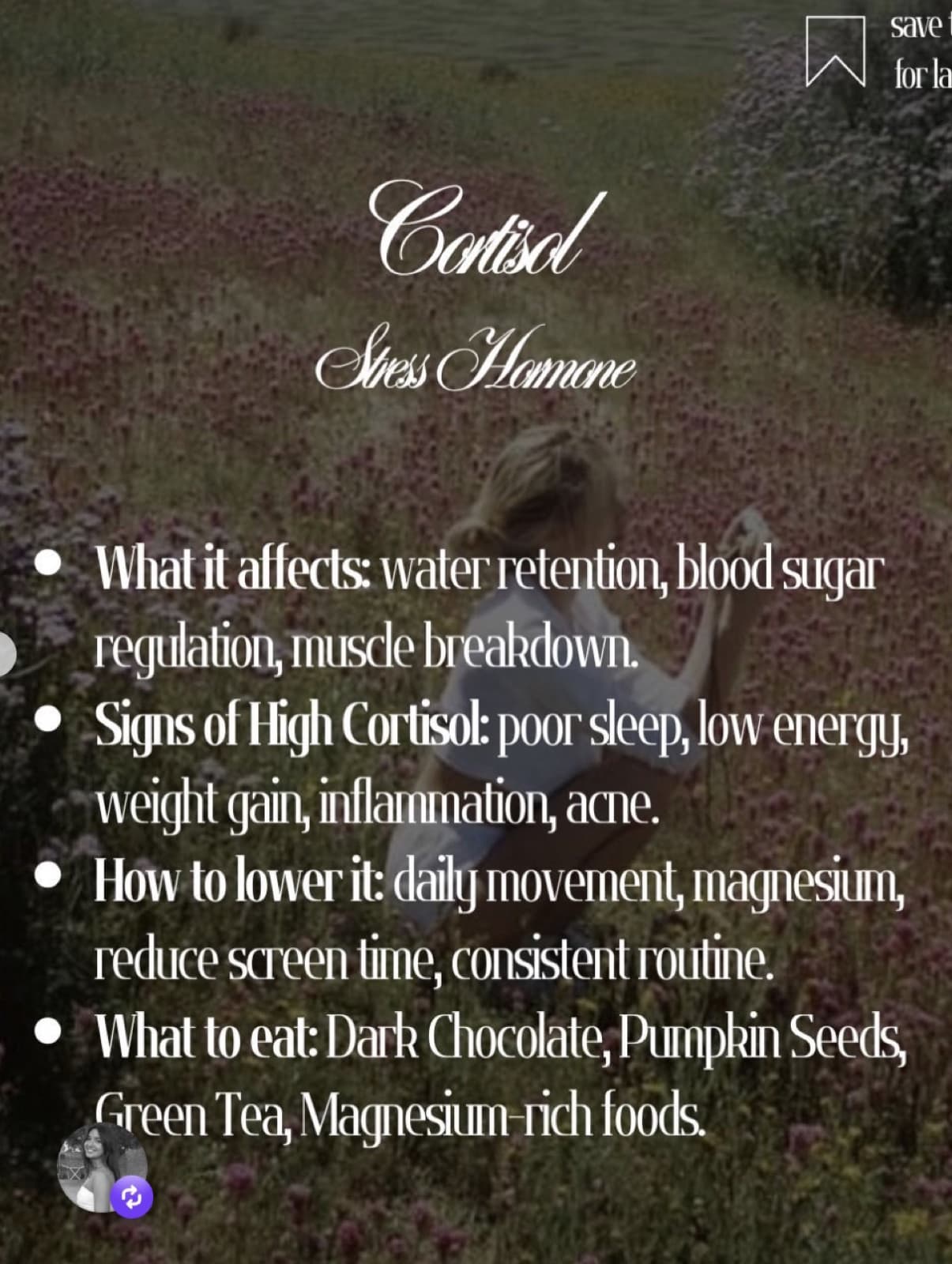
What it affects
Three systems, and none of them are the ones people expect.
Water retention. Cortisol influences how your kidneys handle sodium and water. Chronically high means chronically holding on — which is a large part of the puffiness that gets blamed on salt or carbohydrates. More on that here.
Blood sugar regulation. Cortisol's job in an emergency is to make energy available fast, so it raises blood glucose. Do that all day, every day, and insulin is working constantly to clear glucose you never actually used running from anything.
Muscle breakdown. To supply that glucose, cortisol will break down muscle protein. Which is why people under sustained stress can train consistently and eat well and still watch composition move the wrong way.
The signs
Five, and they're almost always treated as five unrelated problems by five different people.
Signs of high cortisol
Poor sleep · Low energy · Weight gain · Inflammation · Acne
The tell is the cluster. Any one of these has a dozen causes. All five at once, arriving in the same season of your life, is a pattern — and it's worth reading as one thing rather than five.
The sleep one is the most diagnostic. Specifically: falling asleep fine and waking at three or four in the morning, alert, thinking. That's a cortisol curve arriving hours early, and it's the clearest signal on the list.
Why "managing stress" is the wrong goal
People often focus on "managing" stress, rather than addressing what is driving cortisol in the first place.
Managing stress means getting better at carrying a load. It's a coping skill and it has real value. But it doesn't reduce the load, and your endocrine system responds to the load.
The actual mechanism
When your body feels nourished and safe, cortisol naturally lowers. Not because you forced it down — because you removed the need for constant fight-or-flight.
Safety is a state your body infers from inputs. You can change the inputs.
The inputs it reads are unglamorous and specific: are you eating enough and regularly, is light arriving when it should, is sleep happening at a consistent time, are you moving, and is there anyone you can say the true thing to. Those are the levers. Not an app.
How to lower it
Her four, which are the right four:
Daily movement. Walking counts and often counts more. Hard training on top of chronic stress adds load rather than discharging it — this is the one that catches high-achieving people out.
Magnesium. Depleted by stress, and needed for the systems that regulate it. Food first.
Reduce screen time. Both the light and the content. Blue light at night delays melatonin; the content keeps threat-detection running.
A consistent routine. Cortisol is circadian. It wants to peak in the morning and fall at night, and it takes its cues from regularity. Same wake time, most days, does more than any supplement.
And the fifth she names in the caption, which belongs at the top: eat enough. Under-eating and skipping meals are cortisol events. This is where people who are trying hardest often go most wrong.
What to eat
Dark chocolate and pumpkin seeds are both magnesium. Green tea gives you L-theanine — the compound that produces alertness without the cortisol spike, which is the honest argument for matcha over coffee on a stressed week.
Also, less obviously: carbohydrates. Chronic under-eating of carbohydrate is a cortisol driver. Steady blood sugar is the goal, not low.
Where people go wrong
- Adding a hard training block during a stressful period. Exercise reduces cortisol at moderate doses and raises it at high ones. Context decides which you're doing.
- Fasting longer to feel more in control. Skipping meals raises cortisol. Directly counterproductive.
- Treating the five signs as five problems. A dermatologist for the acne, a trainer for the composition, a supplement for the energy — and nobody looking at the pattern.
- Ten minutes of meditation at 10pm to undo a day the body read as a threat. Better than nothing, nowhere near sufficient.
- Cutting carbohydrates while already stressed. The two combine badly, particularly in the luteal phase and in winter.
- Buying an ashwagandha supplement before fixing the wake time. One is free.
The one thing
Same wake time every day this week, including the weekend, and light on your face within an hour of it.
Cortisol is a rhythm before it's a quantity. Give it a rhythm and the quantity often follows without you doing anything else.